

By Joshua Barber, Managing Director of Pricing
“Perfect Storm” Driving High Energy Costs
In the last few years, we have seen energy prices not only rise in priority within the energy space, but breakthrough into the class of “kitchen table” issues that lead the news and become top issues in statewide elections. Across the United States, particularly in the Northeast region, 2025 brought a notable increase in interest around energy prices and the corresponding mechanics that drive them. We knew winter 2025-2026 was going to be more scrutinized than usual. Then a “perfect storm” of cost drivers resulted in the type of energy prices that reshape policy and serve as a benchmark for future risk management strategies.
Market Overview
Rebounding from a surprisingly cold 2024-2025 winter, forecasts were cautiously optimistic for a mild season this year. And it was exceptionally warm and dry for most of the country, with the average across the Continental U.S. from December to February being the second warmest on record. However, the Northeast showed a sustained pattern of cold temperature throughout the winter with several severe storms that tested the regional energy infrastructure and sent prices soaring.
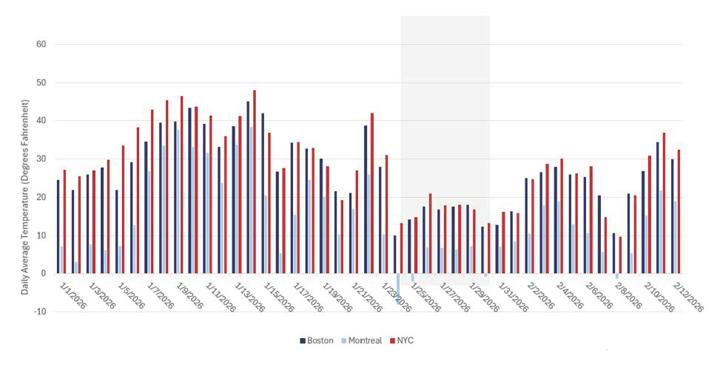
Figure 1: Daily Average Temperature in Boston, Montreal & NYC early 2026, Competitive Energy Services
This cold weather was most acute during Winter Storm Fern, which pummeled the region with snow and delivered several days of frigid temperature. Climbing demand for natural gas, which serves as both the primary fuel for heating and electricity generation in the region, sent prices soaring. During the week of January 24 – 30 spot gas pricing averaged $62/MMBtu at Algonquin Citygate in Boston. The highest priced prior week of the year averaged about $15/MMBtu. On Tuesday January 27, Spot pricing peaked at $124/MMBtu which nearly set a record in New England. Likewise, electricity spot pricing averaged $150/MWh in January 2026, a 15% year-over-year increase, and 87% higher than the three-year average.
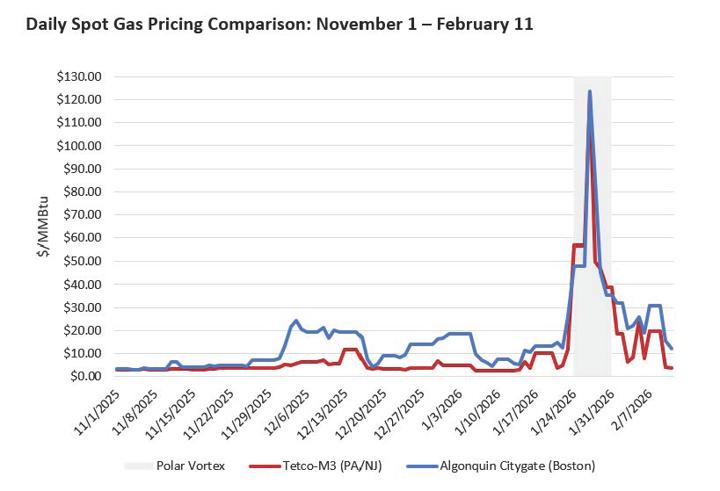
Figure 2: Daily Spot Gas Pricing Comparison by Pipeline, Competitive Energy Services
Most people are not directly purchasing their gas and electricity on the spot market. For our clients in the retail space, energy is purchased well in advance at a negotiated price. However, they are not fully insulated from extreme weather and peaking spot prices. This winter, both gas and electricity contracts were subject to special terms driven by regulatory changes and reliability programs.
During the extremely cold days, the system operator for the gas network took precautions called Operational Flow Orders (OFOs). OFOs are directives issued by natural gas utilities or interstate pipelines during periods of stress. OFOs are intended to maintain supply for the entire system by overriding some previously contracted supplies and assessing financial penalties for significant deviations in usage from expected levels. Retail natural gas contracts contain provisions for these periods of stress and are important for consumers to understand. Many natural gas consumers were impacted by OFOs issued by their local utility during the winter of 2025-2026, often with substantial one-time costs. Experts from Competitive Energy Services (CES) work to negotiate OFO provisions in contracts for our clients. We also independently monitor market costs, so we can clearly explain charges and make informed recommendations tailored to each client’s needs.
The electricity system also runs programs to ensure reliability and safety of the grid. ISO New England (ISO-NE), the regional transmission operator for the New England region, launched a new program in March 2025 to maintain sufficient capacity when demand is the highest. Day-Ahead Ancillary Services (DAAS, sometimes referred to by its original title DASI), contracts capacity for the next day outside the typical energy market.
This program pays generators, particularly fossil fuel resources in our region, to reserve some of their capacity for reliability rather than selling 100% of it on the real-time market. While this objective is an important one, DAAS moved costs that were previously predictable, modest and relatively seasonal into the volatile day-ahead market. After the first 12 months of the program, DAAS has cost approximately $1 billion more than ISO-NE projected, or about 10 times the cost to consumers compared to the program it replaced. Suppliers bear that cost when they procure power and then pass it onto utilities or clients directly. Depending on when retail customers signed contracts, they have been exposed to a different percentage of that cost. The volatility of the new DAAS program, as well as upcoming changes to the Forward Capacity Market planned for mid-2028, has made fully-fixed products less common in the retail market and has majorly increased the premium being charged for fixed products. ISO-NE has recognized the strain this kind of cost and uncertainty has on markets, and they have proposed corrections to DAAS going forward that they hope will bring down costs and deliver more certainty in both mild and extreme weather conditions.
Just as temperatures started to rebound and energy markets began to settle in March, the conflict in Iran shook oil and gas supply chains. Shutting down shipments through the Strait of Hormuz, and attacks on other major oil and gas infrastructure in the Middle East have caused near- and long-term markets to swing dramatically. While conditions continue to evolve daily, the production delays and reductions already identified are expected to put upward pressure on prices well into the future.
After winter 2025-2026 brought sustained cold, acute spikes in spot prices, regulatory upheaval, and now geopolitical uncertainty, making any type of long-term commitment on energy can feel daunting. And acting today may not be advisable in every case. But it is an ideal time to review your energy costs from this winter, identify solutions, and make an executable plan going forward.
Competitive Energy Services advocates continuous market monitoring as the best energy rates can occur at any time of the year. Those windows of opportunity may be smaller this year, so meeting with a CES Energy Services Advisor to identify key price points and terms is even more important. Energy affordability is even more likely to be a topic of concern for your organization this year. Working with the independent experts at CES means you will be better prepared to address it going forward, regardless of what changes come next.
Photo by: Douglas Rissing